

Snapshot at 10:00. Replication at 10:12. Disaster at 10:45. Is Your RPO 33 or 45 Minutes?
A snapshot was created at 10:00 AM.
Replication completed successfully at 10:12 AM.
A disaster occurred at 10:45 AM.
Your production site is completely unavailable.
Assume the 10:00 AM snapshot is the latest valid and recoverable point available at your DR site.
What's your actual Recovery Point Age: 33 minutes or 45 minutes? And why?
The question looks simple, but the answer depends on an important distinction in Disaster Recovery architecture:
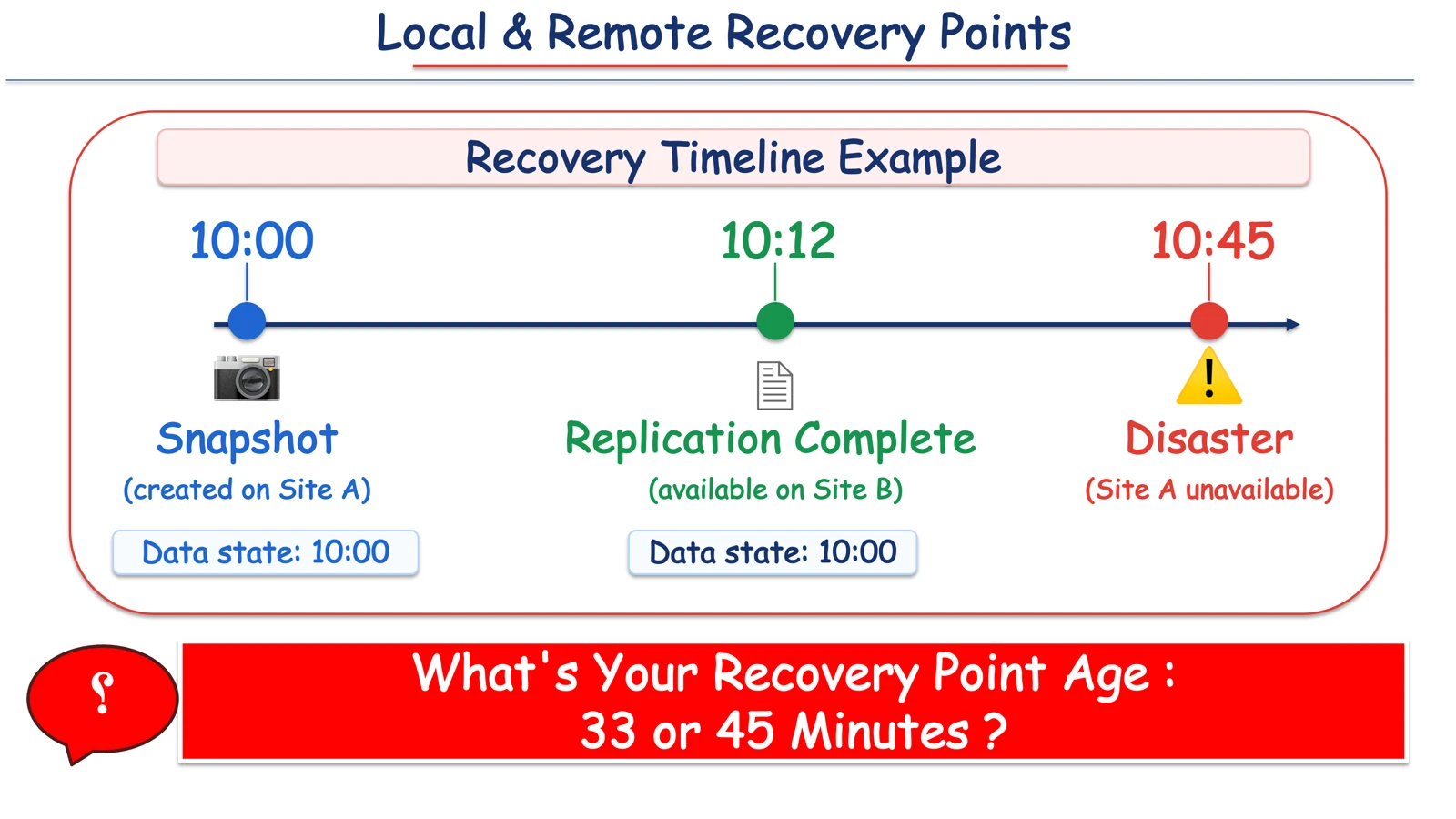
Is the replication completion time the same as the timestamp of the data you can actually recover?
Let's break it down.
1. The Architecture Scenario
Consider two Nutanix clusters:
-
Site A: Production Cluster
-
Site B: Disaster Recovery Cluster
A protected workload has a snapshot created at 10:00 AM on Site A.
The snapshot represents the workload's point-in-time data state at 10:00 AM, within its consistency guarantees.
Replication transfers the required data and metadata to Site B, completing successfully at 10:12 AM.
At 10:45 AM, a complete site failure makes Site A unavailable.
Here's our recovery timeline:
| Event | Time |
|---|---|
| Snapshot created on Site A | 10:00 AM |
| Replication completed on Site B | 10:12 AM |
| Production site failure | 10:45 AM |
Now the question is:
Does Site B hold the data state from 10:00 or 10:12?
2. Snapshot Time vs. Replication Completion Time
This is where an important distinction comes into play.
Snapshot Time: 10:00 AM
This represents the point-in-time state of the protected data.
Replication Completion Time: 10:12 AM
This represents when the replication operation finished and the recovery point became available at the destination.
When replication completes at 10:12 AM, the recovery point does not become a new 10:12 AM data state.
It still represents the data captured at 10:00 AM.
Replication changes where the recovery point is available, not the point in time it represents.
3. Local vs. Remote Recovery Points
A local recovery point may help restore workloads after certain logical failures, such as accidental changes or data corruption, while the production environment remains accessible.
However, a local recovery point alone is insufficient if the entire production site becomes unavailable.
For site-level Disaster Recovery, we need a valid recovery point available at the remote destination.
In our scenario:
-
Local Recovery Point: Created at 10:00 AM on Site A.
-
Remote Recovery Point: Available at Site B after replication completes at 10:12 AM.
-
Recoverable Data State: Still represents 10:00 AM.
The difference between local and remote recovery points is not necessarily the age of the protected data.
It is their location and availability under different failure scenarios.
4. So, What's the Actual Recovery Point Age?
Let's return to the original question.
The disaster occurred at 10:45 AM.
The latest valid recovery point available at Site B represents the data state at 10:00 AM.
Therefore:
Recovery Point Age = Disaster Time - Latest Recoverable Data-State Time
10:45 - 10:00 = 45 minutes
The answer is 45 minutes, not 33 minutes.
Why?
Because 10:12 AM was the replication completion time, not the timestamp of the recoverable data.
The 33-minute interval tells us how long the remote recovery point had been available before the disaster.
It does not represent the full age of the protected data.
One important clarification:
The 45-minute recovery point age represents the potential data-loss window, not necessarily 45 minutes of actual lost transactions or changed data.
The business RPO is the acceptable data-loss objective, while the observed recovery point age helps us evaluate whether that objective has been met.
5. The Architecture Implications
Configuring a snapshot schedule or replication policy does not automatically guarantee that the required recovery objective will be achieved.
From a Solution Architecture perspective, several factors must be considered:
Data Change Rate
How much data changes between recovery points, and can the replication infrastructure handle that volume?
Network Bandwidth
Is there sufficient effective bandwidth to transfer the required data within the intended protection window?
Destination Capacity
Does the DR cluster have adequate capacity and resources to retain the required recovery points?
Monitoring & Recovery Testing
Are recovery points arriving at the destination within the required time, and have they been validated for actual recovery?
These considerations are especially important when designing asynchronous replication strategies for workloads with strict recovery requirements.
Configured RPO is a design target, not an automatic guarantee of achieved recoverability.
6. The Architecture Takeaway
A snapshot created on the production cluster is not automatically a recovery point available at the DR site.
And successfully completing replication does not change the timestamp of the data state represented by that recovery point.
For DR architecture, the critical question is not simply:
"When was the last snapshot created?"
Or:
"When did replication finish?"
It is:
"What's the latest valid and recoverable point available at the DR site?"
Ultimately, recovery objectives must be validated against the data that can actually be recovered, not just the configured replication schedule.
Community Discussion
For those designing or operating Nutanix Disaster Recovery environments:
How do you monitor and validate the age of the latest recoverable point at your DR destination?
Do you rely primarily on the configured replication schedule, replication monitoring and alerts, or regular recovery testing?
And during a DR exercise, do you explicitly measure the recovery-point age against the business RPO requirement?
I'd be interested to hear how other architects and engineers approach this in real-world environments.
