



What We Learned About NKP
This year, operational simplicity has emerged as a key consideration in competitive evaluations against Red Hat, VMware, and Rancher. Operational simplicity can influence the operational factors that organizations should include in a Total Cost of Ownership (TCO) evaluation. If not, the teams that use and manage cloud native platforms for delivering critical apps could be taken off guard and the organization’s leadership will be left with ultimate responsibility for the higher cost associated with operational overhead.
After a year of strong customer interest in our Nutanix Kubernetes Platform (NKP) solution, operational simplicity has emerged as a key consideration.
Key Point—The performance of the software architecture itself, as well as the efficient operational aspects of doing routine Day-2 activities like upgrading and patching, target several factors that contribute to overhead. Let’s examine these factors.
As I get started I could throw in a cute, Gemini-generated image depicting our robust advantage… a cartoonish, superhero exaggeration with a lot of visual stimuli. I’m tempted, but I know AI fatigue is real and many people click away as soon as they see one.
I get it, so let’s look at the comparison this way:
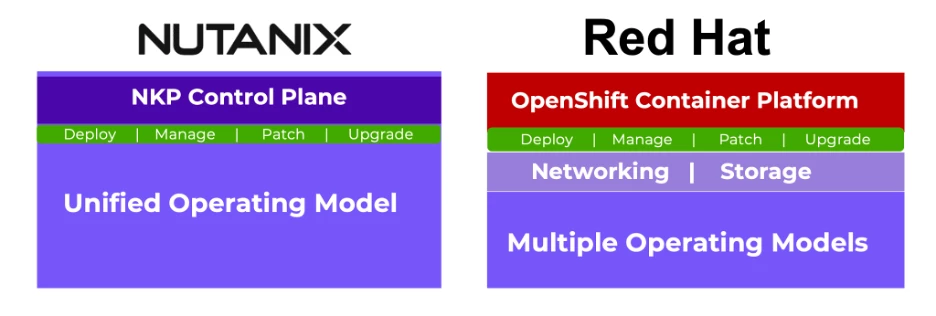
The first diagram shown above highlights a coordinated operating model for the Nutanix stack, using our Nutanix Cloud Infrastructure (NCI) and Nutanix Data Services for Kubernetes (NDK) solutions, with NKP as the control plane across the relevant platform services. In contrast, the second diagram shows how separately sourced storage, networking, and other services may introduce additional operating models and lifecycle considerations around a Red Hat OpenShift Container Platform deployment, depending on the selected architecture. The distinction is not whether both platforms support networking and storage. They do. The operational difference is how those services are incorporated into the broader stack and how many separate lifecycle and management responsibilities the customer must coordinate.
According to this Red Hat OpenShift Container Platform Datasheet, in some OpenShift production architectures, organizations may combine the platform with separately sourced storage, networking, backup, observability, or data-service products to meet their requirements. Those choices may introduce additional integration, qualification, lifecycle, and support considerations. NKP Full Stack, which includes NCI and NDK, is designed to provide a coordinated operating model across Kubernetes, infrastructure, networking, storage, and data services.
Factors Affecting Operational Overhead
Many of us have spent more time than we care to admit watching progress bars inch along or spinning wheels that seem stuck. Is this really the best use of our time? We are troubleshooting in a tense situation often brought on by operational complexity or overhead. Even when things are going well, watching progress indicators is part of the drill and what we signed up for with a career in IT technology software to use or sell.
In general, we might surmise that more complexity from the workflow steps, or multiple environments to manage, makes the overhead increase.
Many of these steps involved in deploying, patching, upgrading, and troubleshooting a component or solution within a software stack are obvious. We can quantify and test these steps for any solution in a competitive scenario. But that’s only part of the analysis.
Operational overhead can show up in several different forms, from the responsibilities that IT owns as a staff to escalations involving support teams that address and fix issues, along with everything in between. Let’s break those pieces apart to pinpoint exactly what could cause unexpected expenses from complexity and operational overhead.
The following table breaks down where customers can reasonably anticipate and model factors affecting operational overhead:
| Factor | What it means | Where cost effects show up |
| Operational tasks and responsibilities | What IT must learn, own, and maintain | Staffing, accountability, and skillsets |
| Operational effort | Time required to perform those responsibilities | Labor hours |
| Operational toil | Repetitive, low-value work from poor design | Productivity loss |
| Integration overhead | Keeping components and platforms working together | Engineering and testing |
| Lifecycle overhead | Patching, upgrades, compatibility, and version dependencies | Change windows and validation |
| Support overhead | Diagnosing problems across products and vendors | MTTR and escalation time |
Individually, none of these necessarily looks dramatic. But TCO is cumulative. A few extra hours here, another integration there, another specialist required somewhere else, another upgrade dependency to test.
Operational coordination can become more involved when multiple vendors and operating models participate in interdependent processes.
How about support?
I mentioned this the other day, and a veteran of a well-known multiple vendor environment reminded me of difficulties they had coordinating support across their multiple vendor estates. When an issue spans applications, infrastructure, networking, or storage, getting to the root cause can mean working across several support teams, each responsible for a different piece of the puzzle.
These interactions can become tense, sometimes with pressure-induced bickering that goes well beyond the usual technical considerations. Repeated troubleshooting steps and plenty of waiting while everyone tries to determine where the problem lies and who is responsible for fixing it just take time and make people grumpy.
Plugins and Operational Overhead Impact
Some solution platforms provide a common management experience across components that may still retain separate release, support, or lifecycle processes. That’s useful, but integration at the management layer doesn’t necessarily mean that the components share the same lifecycle underneath.
A good example is plugin software. From an operator’s perspective, a plugin can create what looks like a nicely integrated experience on the user interface. The underlying products may retain separate release, qualification, support, and upgrade considerations, depending on the selected products and versions. A common management experience does not necessarily eliminate the underlying lifecycle, qualification, support, or upgrade considerations.
CLI Usage Doesn’t Kill Complexity
Many cloud native workloads run and are managed by code that is pretty standard across solutions. Operators include CLI commands in whatever they configure or automate. In most cases anything that you can do from an end user, graphical user interface (GUI) has a CLI equivalent. Each solution will also have APIs that you can use to configure and manage your workloads.
As networking, storage, infrastructure, security, backup, observability, and other services introduce their own control planes, operators may also inherit additional contexts, credentials, APIs, version dependencies, and command-line tools.
The overhead isn't simply having another command to type. It's coordinating state and lifecycle across the systems behind those commands.
A CLI does not by itself eliminate operational coordination. It can shift coordination into contexts, credentials, sequencing, APIs, and state across the systems being managed.
Final Thoughts
Adding another control plane may introduce additional operational responsibilities, skill requirements, integration points, lifecycle considerations, and troubleshooting paths.
To help you include this type of discussion while making a decision between Nutanix and Red Hat specifically, e.g., a comparison of NKP and Red Hat with TCO considerations, reach out to your Nutanix account executive or one of our certified partners to get an analysis underway.
To find out more NKP and our cloud native solutions, check out the following:
- The Strategic Value of Operational Efficiency
- Navigating the True Cost and Capability Gap: Nutanix vs. VMware Explained
- Nutanix Cloud Native Community
- Nutanix University: NKP Playlist
- Simplify Cloud Native Kubernetes Management
- Nutanix Kubernetes Platform
- Application-Level Data Services for Kubernetes
FAQ for TCO and Operational Overhead
Q: What operational considerations can organizations evaluate when comparing Kubernetes platforms?
NKP is designed to help coordinate operational responsibilities across supported Nutanix infrastructure, Kubernetes, storage, networking, data services, lifecycle management, and support. Any operational or TCO impact depends on the customer’s architecture, configuration, staffing, requirements, and cost assumptions.
Q: What factors contribute to "operational overhead" in IT environments?
Operational overhead goes beyond just deploying, patching, and upgrading software. It includes operational responsibilities (what IT must learn and maintain), operational effort (labor hours), integration overhead (keeping platforms working together), lifecycle overhead (managing dependencies and change windows), and support overhead (diagnosing problems across multiple vendors).
Q: Do integrated management plugins eliminate operational complexity?
Not necessarily. While plugins can provide a nicely integrated experience in the management layer, the underlying products still maintain their own separate release and support lifecycles. You still have to navigate version dependencies and upgrade sequencing.
Q: Doesn’t standardizing on command line interfaces (CLIs) remove operational complexity?
No. While CLIs are standard, adding extra control planes means operators inherit additional contexts, credentials, APIs, and version dependencies. The CLI doesn't make operational complexity disappear; it simply shifts that complexity into coordinating state, sequencing, and credentials across multiple systems.
Q: How does a unified control plane benefit my operations?
A coordinated operating model may help organizations evaluate and manage the operational factors that contribute to TCO when multiple vendors, operating models, and lifecycle processes are involved.
© 2026 Nutanix, Inc. All rights reserved. Nutanix, the Nutanix logo, and all Nutanix product and service names mentioned herein are registered trademarks or trademarks of Nutanix, Inc. in the United States and other countries. Nutanix, Inc. is not affiliated with VMware by Broadcom or Broadcom. VMware and the various VMware product names recited herein are registered or unregistered trademarks of Broadcom in the United States and/or other countries. Red Hat and OpenShift are registered trademarks or trademarks of Red Hat, Inc. or its subsidiaries in the United States and/or other countries. Kubernetes is a registered trademark of The Linux Foundation in the United States and other countries. All other brand names mentioned herein are for identification purposes only and may be the trademarks of their respective holders.